

What High-Frequency Substack Growth Looks Like When It’s Structural (Not Tactical)
I conducted an analysis on a high frequency Substack publisher and here is what I found

Most advice on how to grow on Substack focuses on tactics.
Publish more often.
Write better headlines.
Use Notes.
Swap recommendations.
None of this is wrong. But it skips a more important question.
Why do the same actions create momentum for some writers and burnout for others?
Tactics explain what people do.
They rarely explain why those actions work together for some writers and fall apart for others.
NewsletterLab studies that difference.
This is not a how-to guide. It is a case study in structure. It looks at what steady Substack growth looks like when it comes from a clear, repeatable system instead of a rotating list of tricks.
As Substack gets more crowded and discovery shifts toward Notes and recommendations, systems that reduce reader confusion matter more than ever.
Why This Substack Case Study Is Worth Analyzing
This analysis looks at the public body of work from Matt Giaro, a long-running Substack writer who publishes at high frequency.
This is not about praising results or copying style.
It is about visibility.
The system is easy to see:
posts show up often
the same ideas appear again and again
the positioning barely changes over time
That makes it useful for understanding structure rather than outcomes.
What We Analyzed (and What We Ignored)
To keep this analysis clean, we ignored:
tone and personality
writing style and rhetoric
monetization results
individual growth tactics
Instead, we focused on:
the mental state the content speaks to
which ideas repeat over time
how posts are framed and ordered
how stable the core message remains
The goal was not to pull out advice.
It was to see what stays the same.
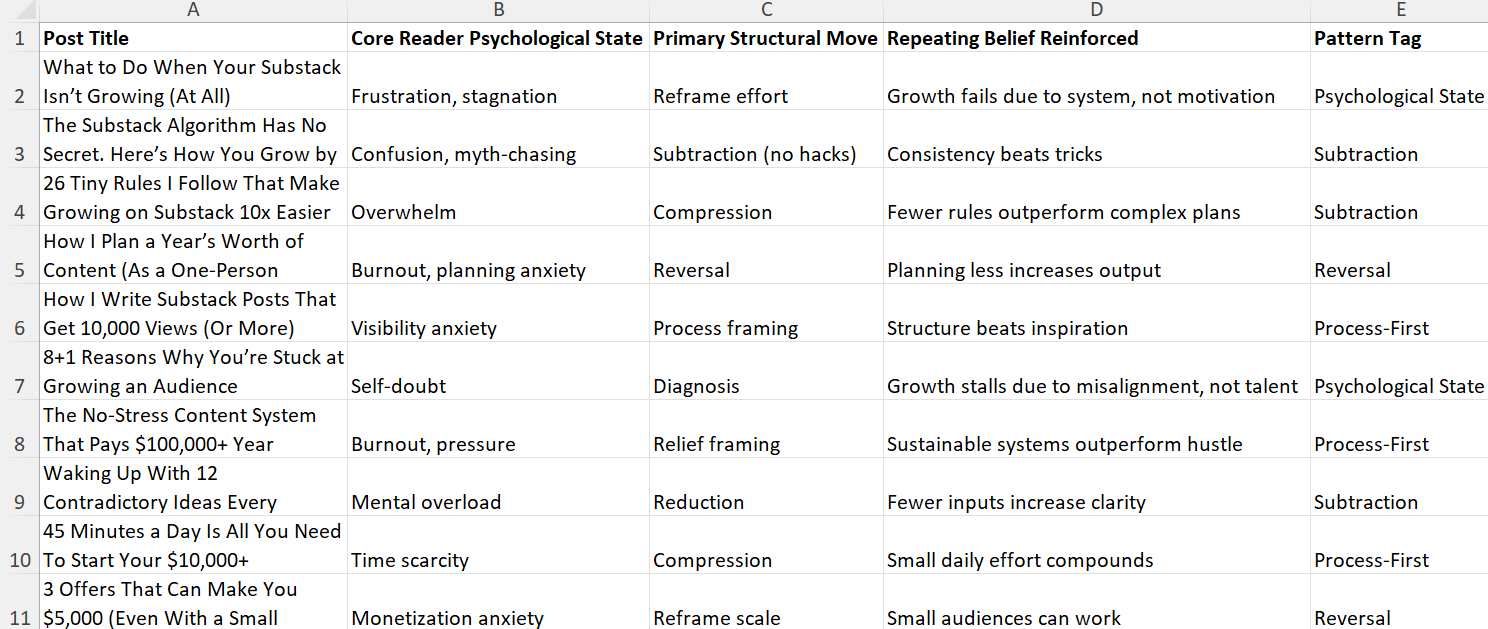
Pattern 1: Writing for a Psychological State, Not a Demographic
Across posts, the intended reader stays consistent.
Not by age or profession, but by mindset.
The reader is usually:
overwhelmed by too much advice
frustrated despite real effort
stuck optimizing instead of moving forward
unsure what actually matters
Each post reduces that tension. It does not add steps. It simplifies the problem.
What this does:
Readers do not have to ask “Is this for me?” every time. The content keeps meeting them in the same mental place.
Pattern 2: Subtraction as the Core Growth Mechanism
Most posts do not add complexity. They remove it.
You see repeated moves like:
dismissing detailed content calendars
cutting down tool stacks
rejecting multi-platform strategies
reframing productivity as doing less
The emotional result is consistent. Relief.
What this does:
The newsletter becomes easy to keep reading. Growth comes from lowering mental effort, not increasing novelty.
Pattern 3: Repetition Without Drift Builds Trust
The same beliefs appear again and again:
consistency beats brilliance
systems beat motivation
one platform beats everywhere
simplicity beats optimization
These ideas are not replaced. They are repeated.
Readers are not asked to learn a new framework every week. They see familiar ideas applied to new situations.
What this does:
Predictability builds trust. Readers know what the newsletter stands for before they open it.
Pattern 4: Process-First Framing Sustains Long-Term Growth
Results are rarely the headline.
Instead, posts focus on:
daily routines
repeatable behaviors
fixed time blocks
Credibility comes from showing the work, not promising outcomes.
What this does:
Readers are not asked to believe claims. They are invited to observe a process that stays consistent over time.
Why Structural Growth Compounds on Substack
Taken together, these patterns create a low-friction loop.
Readers quickly recognize the problem being addressed.
They know the kind of clarity they will get.
They understand the belief system behind the writing.
This removes common questions:
Should I read this?
Will this contradict what I read before?
Do I need to learn a new system again?
The answer is almost always no.
On Substack, where trust builds slowly and attention compounds, that consistency is the growth engine.
A Simple Contrast: What Stalled Growth Often Looks Like
Many stalled newsletters do the opposite:
they expand topics instead of narrowing them
they rotate beliefs instead of reinforcing them
they chase new tactics instead of stabilizing a system
The problem is not lack of effort. It is uncertainty.
When readers have to keep figuring out what a newsletter stands for, growth slows, even if individual posts perform well.
What This Case Study Does Not Prove
This analysis does not mean:
high-frequency posting works for everyone
this structure fits every audience
copying surface tactics will recreate results
Different audiences need different systems.
This is one working configuration, not a universal rule.
What NewsletterLab Is Actually Studying
This post is not about one writer.
It is about spotting when Substack growth comes from:
structure instead of tactics
repetition instead of novelty
psychological fit instead of cleverness
NewsletterLab exists to make those patterns visible so creators can understand why certain systems compound before deciding what to copy.
If this resonated, you will likely start noticing the same structural signals in other newsletters, even when the topics are completely different.
More from Newsletterlab


If this kind of structural analysis helps explain why some Substack newsletters grow steadily over time, future posts will examine similar systems across different niches, publishing frequencies, and reader mindsets.