

How I Used Audience Overlap Data to Engineer My Next High-Performing Post
What if the fastest way to grow wasn't more content… but better alignment? Here’s how I used other writers’ audiences to design a post that hit harder than ever.


👀 Why Audience Overlap Is Your Secret Growth Hack
My audience overlaps with some seriously high-performing Substack writers.
Instead of just admiring their work, I got curious:
What if I could reverse-engineer what their audience responds to… and craft posts that slide into that desire stream?
So I built a process, and discovered a repeatable way to read the room before I ever write a word.
Sorry to pause you there but this is important.
🗓️ Publishing Schedule Update
Starting this week, Newsletter Lab will land in your inbox every Friday at 10 AM PDT (or Saturday 10 AM PDT.
Expect deep dives, reverse-engineering breakdowns, and growth tactics; right on time.
Let’s move on!
🛠️ My 4-Step Reverse-Engineering Process
Step 1: Pulled Substack Audience Overlap Data
I identified 5–7 Substack writers with meaningful subscriber overlap using the native “Audience Overlap” feature. These weren’t just random picks, they reflected where my actual readers already hang out. That gave me a data-backed foundation to study what works.
Step 2: Scraped and Mapped Post-Level Signals
No API or scraping tool. I did it manually. I collected top posts, screenshots, PDF exports, and “Notes” activity from each overlapping writer.
From there, I created a structured dataset that included:
Post TitleSubtitle / One-liner SummaryTopic CategoryEmotional Hook UsedCall-to-Action PresenceFormat(essay, teardown, listicle, dialogue, etc.)Tone / Energy Level(empathetic, tactical, poetic, hype, etc.)Comment Sentiment & TypeLikes & Comments CountCTR & Open Rate (if known)Publishing CadenceAudience Type Estimated
Step 3: Built a Private Labeling System
Every post was tagged by:
Hook Type: Question, Data Teaser, Confession, Promise
Format: Blueprint, Mini Essay, Case Study, Resource Drop
Theme Cluster: Self-Knowledge, Monetization, VC Trends, Burnout, Creative Systems
Tone Layer: Reflective, Urgent, Encouraging, Analytical
This gave me a mini training set.
A GPT-style corpus of what real readers respond to.
Step 4: Modeled Audience Personas & Post Fit
I went a layer deeper and clustered followers across these overlapping writers using:
Their bio keywords
Their post reactions (what tone they engage with)
The content they highlight or save
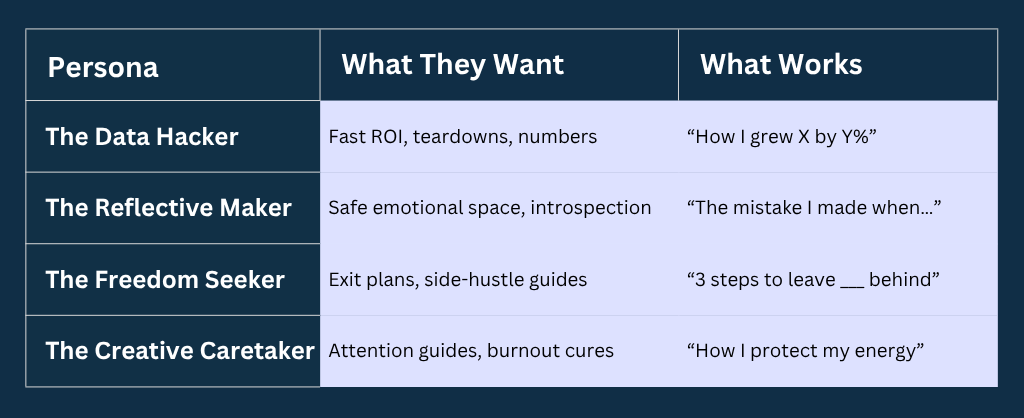
This surfaced 4 core reader types (like “The Data Hacker” or “The Reflective Maker”). Then I mapped post styles to reader types to find high-fit patterns — which post formats land where, and why.
👥 The 4 Audience Personas I Uncovered
🔬 What The Top Posts Had In Common
80% of high-performing titles used numbers or outcomes
Examples:
“How I boosted open rates by 47%”
“The 3-step plan I’d use if I started over”
3 Repeatable Structures Emerged:
🔍 Data Teardown (quick metric, reveal a trick)
🧠 Narrative Hook (story or tension point)
🔧 Mini System / Steps
💬 Sticky Takeaway (one-liner close)
📊 I Built a Heatmap (Format vs. Engagement Theme)
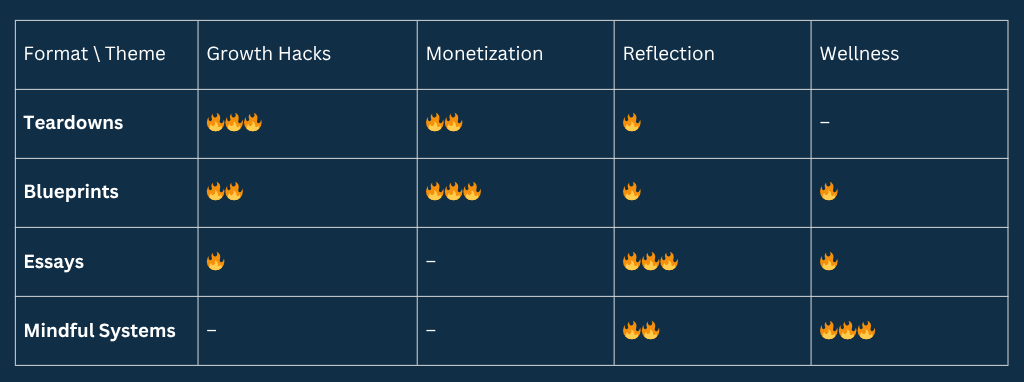
Opportunity gaps I saw:
👉 Posts that combine emotional narrative + blueprint
👉 Posts that feel like burnout recovery meets data strategy
✍️ Writing Prompts I’m Testing Next
“The default behavior killing your growth (and how I broke mine)”
“3 mental models I stole from corporate quitters”
“What 90% of creators get wrong about monetization psychology”
Each of these maps to a persona and fills a heatmap gap.
📦 My Toolkit (Yes, I Built One)
A spreadsheet tagging 50+ top posts by format/style/impact
A persona mapping grid based on follower bios + reactions
A prompt generator sorted by cluster + emotion
A graph showing “title format vs. average comment density”
I’ll probably turn this into a small public resource soon. DM me if you want access early.
🚪 Final Thought
You don’t need to copy what works.
You need to understand why it works, who it works on, and where the gaps are.
Once you see the terrain, you don’t compete. You co-create with the audience that's already halfway listening.
Let me know if you’d use this system, and if you want the prompt templates, I’ll share them in a future drop.
You May Also Read:
Build a Persona in 15 Minutes. No Interviews. No Guesswork.

What if you could build a razor-sharp persona in the time it takes to brew your coffee?


This is sharp and incredibly useful. Love how you moved beyond trend-chasing into actual audience alignment.
Would definitely use this system.
in quiet strength and sound,
Afterforever ✨🎵
Hey Celia, I am glad you find this helpful. Thanks a lot for your kind words!🙏